Join the foundation and contribute to the future of robotic infrastructure & protocols
Apply today


Originally published by Tashi on 25 July 2026. Full essay reproduced below.
The factory of the future is no longer a concept, it is already here. Over one thousand Tesla Optimus Gen 3 humanoid platforms are now scaling across active Gigafactory lines, while Figure 03 units execute complex sequencing at BMW’s Spartanburg facility. Boston Dynamics has integrated its Atlas platform into active manufacturing trials at Hyundai, and Agility Robotics’ Digit is executing continuous tote-handling routines inside Amazon and GXO fulfillment hubs.
This humanoid expansion is further supported by production deployments from Apptronik, Sanctuary, Unitree, Fourier, and UBTech, all operating within spaces simulated and optimized via orchestration tools like NVIDIA Isaac.
But beneath this robotic renaissance lies a critical operational question: how do competing vendors’ fleets safely and seamlessly work together on the same floor?
The universal bottleneck across these state-of-the-art facilities isn’t hardware, it is the fragility of centralized software integration. Modern warehouse orchestration still relies on a single-master database or control layer. If the central WMS server experiences a localized network latency spike or fails during peak operating hours, a billion-dollar facility instantly grinds to a halt. To avoid that kind of downtime, humanoid platforms, Autonomous Mobile Robots (AMRs), and automated machinery need a shared, low-latency, tamper-evident state layer to execute handshakes directly at the edge.
Because industrial facilities are inherently multi-vendor environments, operators cannot afford proprietary, vendor-locked orchestration software. A Tesla humanoid and a Figure platform must coordinate on the same factory floor, sharing identical tools, accessing identical charging bays, and passing physical sub-assemblies without routing localized movements through competing corporate clouds.
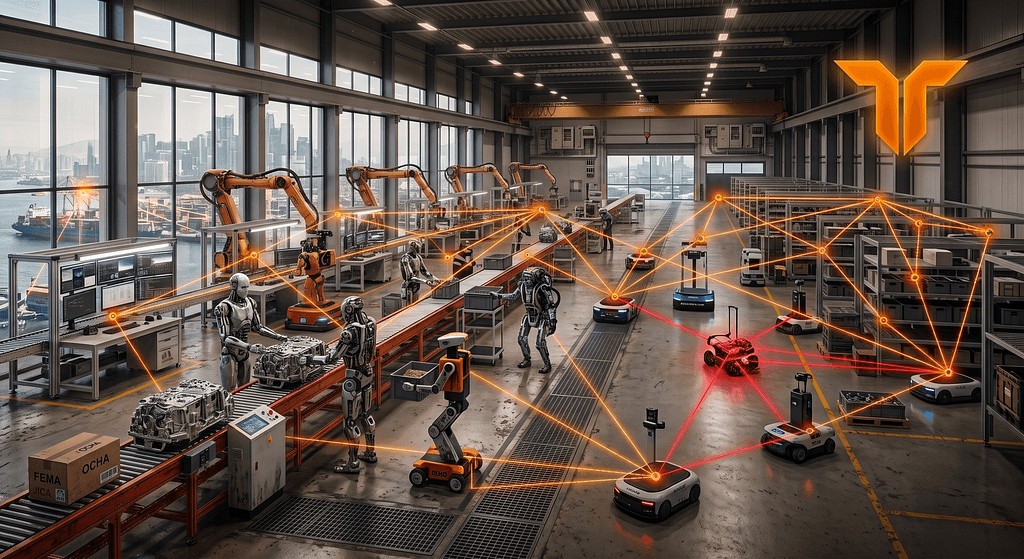
By treating every humanoid, AMR, workstation PLC, and automated conveyor system as a peer node on a local Vertex network, the logistics floor operates as a single, decentralized state machine. Inter-robot tote handoffs, tool validation checks, and inventory pallet claims are processed as hardware-signed ledger transactions.
If a specific humanoid platform experiences a hardware malfunction or goes offline, the floor doesn’t freeze. Surrounding assets instantly detect the node loss and use the native compute_redistribution engine to automatically reallocate pending tasks.
The local DAG serves as a continuous, tamper-evident audit log, delivering the native ISO traceability required for aerospace, pharmaceutical, and defense manufacturing lines, while emergency safety stops propagate mesh-wide within a single consensus round.
